The aloe ferox
stores its medicine
against the drought.
Aloe ferox — bitter aloe, Cape aloe, inhlaba in Zulu — grows on the rocky hillsides of the Western and Eastern Cape. It does not require irrigation. It does not need a mild climate. It grows in conditions that would kill most things.
Each rosette stores a gel — a compound of moisture and medicine — that healers have used for centuries. Burns. Wounds. Inflammation. The plant that survives drought is also the plant that heals.
We borrow the name because the metaphor is exact. A diamond forms under conditions that would destroy anything organic. What emerges is not just beautiful — it is the result of survival.
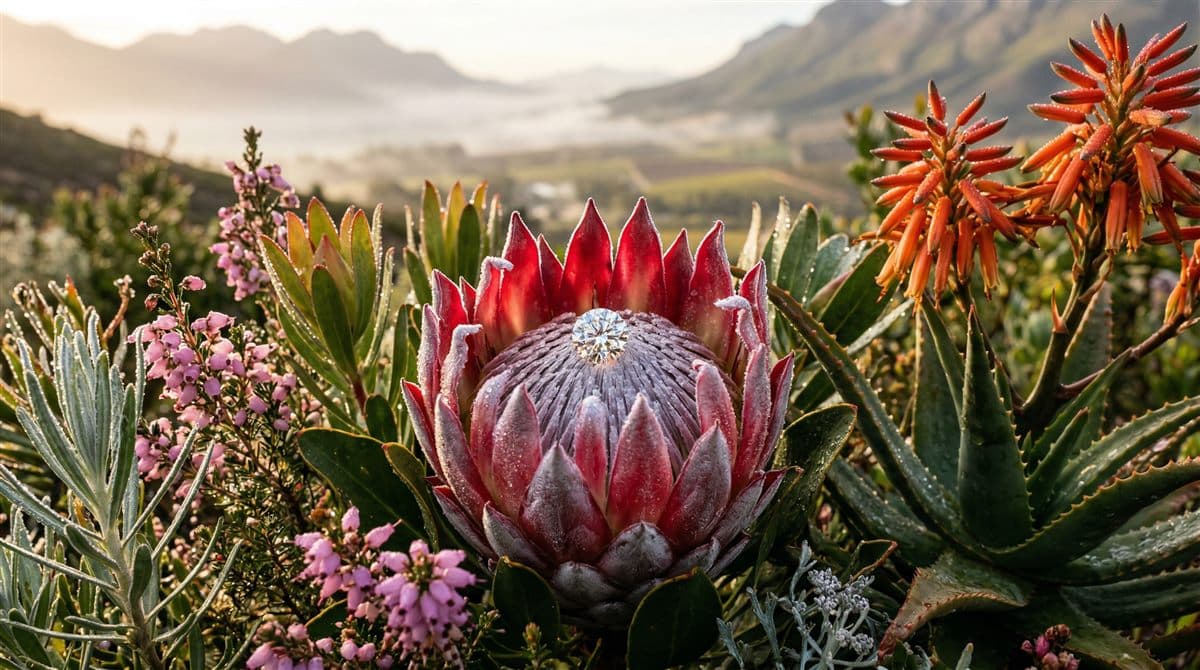
The fynbos requires fire
to renew itself.
The Cape Floristic Region is one of six floral kingdoms on earth. Many of its species — the proteas, the restios, the ericas — can only germinate after fire has passed. The seeds lie dormant until the heat cracks them open.
The Seed
Some protea seeds are held in sealed cones for years, waiting for fire to release them. Patience is not passive.
The Burn
Fire clears the accumulated thatch. Nothing grows through the weight of what came before.
The Bloom
Six weeks after a fynbos fire, the hillside is green. Pressure does not end the story. It begins it.
Our diamonds are not ornaments.
They are reminders.
A reminder that what endures, endures completely. That pressure is a process, not a punishment. That beauty and resilience are the same material, differently cut.
We source certified stones from the global market — natural and lab-grown — and select for character. The aloe is not the most glamorous plant in the fynbos. But it is the one that stays.
The biome is ancient.
The brand is new.
Jan van Riebeeck arrives at the Cape. The fynbos is already ancient.
Aloe ferox trade begins — Cape aloe exported to European apothecaries.
The Cape Floristic Region is formally recognised as a unique biome.
UNESCO declares the Cape Floristic Region a World Heritage Site.
INHLABA is founded. The aloe becomes a diamond house.
The first collection ships direct from Cape Town.